
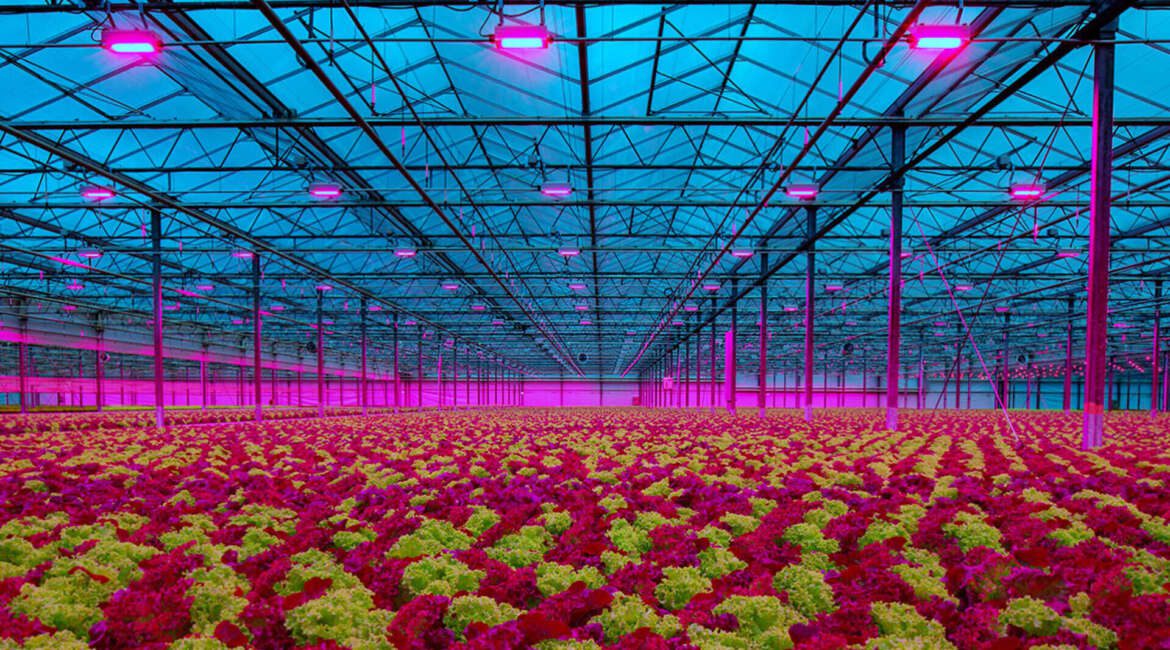
LEDs: A Useful Source of Lighting for Plant Growth
Although ultraviolet (UV) radiation is well known for its sterilizing properties, under some conditions, visible light has been proven to have bactericidal characteristics, allowing it to play an important role in food preservation. Visible light plays an evident role in food production, as well as in agriculture and horticulture, because it stimulates photosynthesis, which is essential for plant growth and development. However, its use in other elements of food preparation receives less attention.
Low light levels are now known to help the crops to retain post-harvest quality by reducing senescence and enhancing phytochemical and nutritional content in a variety of species. In agriculture and food industry, artificial light treatments are being used to disinfect water and food, as well as to enhance plant health and development by employing light energy of various wavelengths.
LEDs operate in a solid-state environment which produce light with limited emission wavelengths, high photoelectric efficiency and photon flux or irradiance, low heat production, compactness & mobility and easy integration into electronic systems. It is a non-thermal food processing method that uses light radiation with wavelengths ranging from 200 to 780 nm. The spectrum features, radiant or luminous intensity, and temporal settings of the light produced may be easily controlled because of LEDs special capabilities.
LEDs constructed from semiconductor materials that produce monochromatic illumination are used in agriculture and food industries due to their benefits over conventional sources. Certain wavelengths of light, as well as pulsed and continuous operating modes can remove hazardous germs in food and water and thus making LEDs very effective. LEDs operate on the electroluminescence concept, which means they produce light under the influence of electric or magnetic field. In order to reach lower energy states, excited electrons in an electric or magnetic field produce light and release energy as electromagnetic radiation. LEDs are made of semiconductor materials that are impurity-laced to create a boundary or interface (known as a p-n junction) among the two categories of semiconductor materials, one being sufficient in holes (the positive or p-type) and the other (the negative or n-type) being sufficient in electrons.
The color and wavelength of light produced are determined by the impurities and semiconductors employed in the LEDs manufacturing process. A semiconductor of p-type could possibly be constructed by infusing an element such as magnesium (Mg) belonging to group II, over any group III element substrate to create more cavities. An n-type semiconductor is created by doping a group IV element into a group III element substrate to provide additional free electrons.
Effect of LEDs on nutritional profile
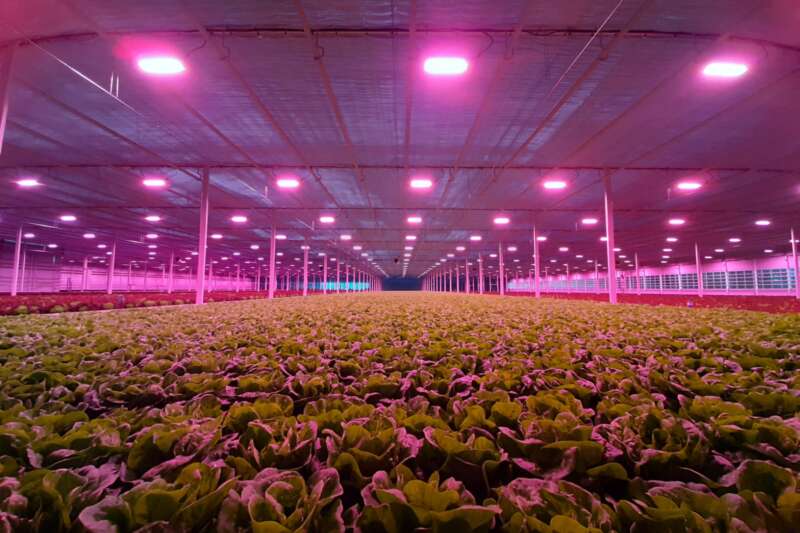
Horticultural produce are significant source of human nutrition. LEDs have been extensively used and considered as a useful source of lighting and are preferred for horticultural produce because they regulate the light source for plant growth. LEDs have the ability to enhance agricultural yield and also improving nutritional value. Taulavuori et al. (2017) reported that the use of blue LEDs is associated with its effect on several metabolic pathways and accumulation of phenolic compounds, polyphenols, carotenoid, ascorbic acid and anthocyanin. Similar trend was reported by (Hasperue et al. 2016). The authors studied the effect of white-blue LEDs on outer and inner leaves of Brussels sprouts for 10 days storage at 22 °C and reported lower respiration rate, better visual quality, with more than 10 times chlorophyll, higher contents of antioxidants and total flavonoids than controls.
LED treatment also increases the antioxidant activity of tomato, Chinese cabbage, pea and Chinese Kale during storage. Studies on the effect of LEDs on overall nutritional profile of cabbage reported the enhancement of total phenolic content, total chlorophyll content, ascorbic acid and decrease in reactive oxygen species.
Impact of Led Lights on Food Preservation
Light-emitting diode (LED) technology is a new non-thermal food preservation method that works by converting light energy into heat. LED has potential to revolutionize crop production, protection and preservation. This technology is economical and environmentally friendly. LEDs have been shown to improve the nutritive quality and shelf life of foods, control the ripening of fruits, induce the synthesis of bioactive compounds and antioxidants and reduce the microbial contamination. This technology also has great scope in countries, where safety, hygiene, storage and distribution of foods are serious issues.
While comparing this technology with other lighting technologies, LEDs can bring numerous advantages to food supply chain from farm to fork. In case of small growing amenities which exploit only LEDs, energy expenditure has been successfully reduced while producing nutritious food. LEDs can be used to give us better understanding and control over production and preservation of food with relation to spectral composition of light.
LEDs also play significant role in food safety by inactivating the food borne pathogens. Therefore, LED lighting is a very effective and promising technology for extending shelf life of agricultural produce by increasing disease resistance and with increased nutritional values.
Effect of LEDs in food system
The effectiveness of LED therapies for solid meals is determined by the kind and character of the end food products, its constituents, as well as the water activity (aw) and surface features of the food. Significant elements that need to be considered are light wavelength, treatment time, dosage, illumination temperature, relative humidity and microbiological conditions.