
Heat Lamps for Restaurants Kitchens: LEDs or no LEDs
In restaurants and commercial kitchens, LED lights are used for general illumination, while traditional incandescent, halogen, or ceramic lamps are used specifically for food warming. This is because LED lights are highly energy-efficient and produce very little heat, whereas the primary function of a heat lamp is to generate substantial infrared (IR) heat.
LED Lighting (General Illumination)
LED lights are the preferred choice for general and task lighting throughout a commercial kitchen due to their efficiency and longevity.
Heat Output: LEDs convert the majority of their energy into light, emitting very little heat into the surrounding environment. This helps reduce the strain on cooling systems in hot kitchen environments.
Energy Efficiency: They consume up to 80% less energy than incandescent bulbs, leading to significant cost savings on electricity bills.
Lifespan: LED bulbs can last for 50,000 to 100,000 hours or more, drastically reducing maintenance and replacement costs compared to other bulb types.
Color Rendering Index (CRI): High-CRI LED lights (80+ or 90+) help staff accurately assess the color and doneness of food, ensuring quality and safety.
Safety: LED lights are durable, often available in shatterproof and vapor-tight fixtures (IP65 or higher rated), meeting strict food safety and hygiene standards (NSF Certified).
Traditional Heat Lamps (Food Warming)
Traditional heat lamps rely on an inefficient process (for lighting purposes) where a filament gets hot and emits substantial infrared radiation (heat), which is their intended function.
Heat Output: Incandescent and halogen heat lamps release about 90% of their energy as heat, making them effective at keeping plated food warm.
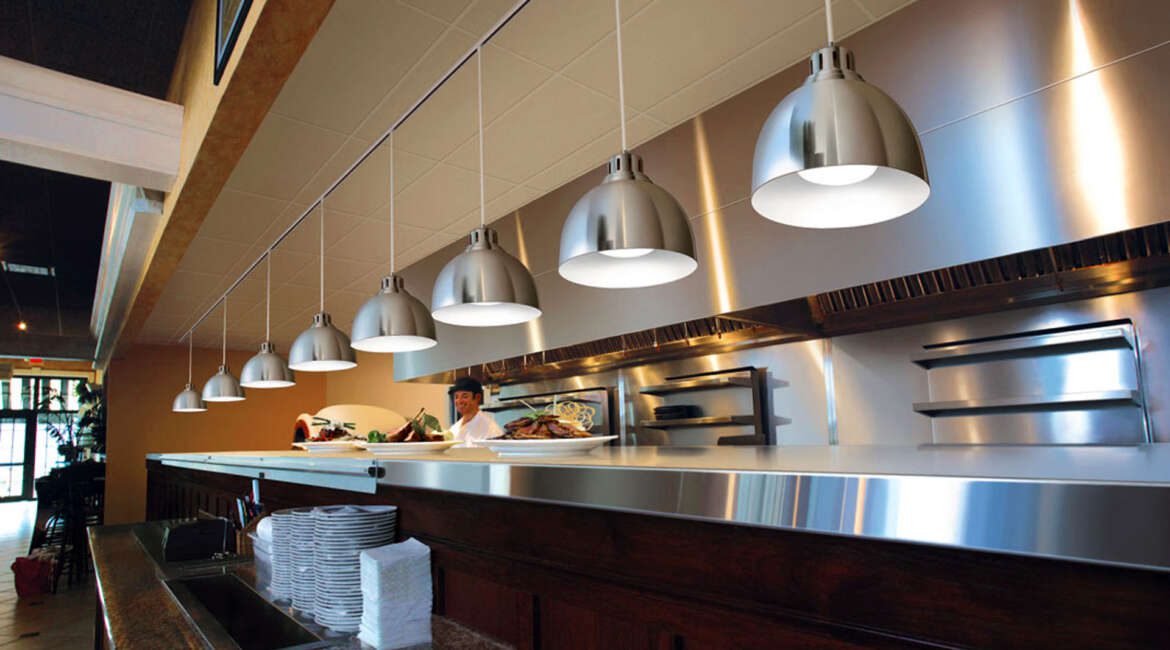
Function: Their specific design is optimized to direct radiant heat onto the food, maintaining safe holding temperatures and visual appeal before service.
Types:
Incandescent/Halogen: Common and cost-effective, they provide a combination of light and high heat.
Ceramic Emitters: These emit no visible light but provide intense, focused infrared heat, which can be beneficial for specific applications where constant light is not desired (e.g., night time holding).
Efficiency (for heating): While inefficient as a light source, they are highly efficient at converting electrical energy into heat (nearly 100%), which is the goal of a food warmer.
Summary of Differences
Feature LED Lights (for general kitchen use) vs Traditional Heat Lamps (incandescent/ceramic)
Primary Function Illumination Heating food
Heat Output Very low (approx. 20% of energy as heat) Very high (approx. 90%+ of energy as heat)
Energy Efficiency Very high for light output Very low for light output (but high for heat output)
Lifespan Extremely long Shorter (like a typical incandescent bulb)
Applications General ambient lighting, task lighting, refrigeration units Above pass-through areas, buffets, warming stations
In short, you cannot use an LED light as a heat lamp because it does not produce enough heat to keep food warm and safe. Conversely, using traditional incandescent bulbs for general kitchen lighting would be extremely inefficient and contribute excessive ambient heat. The two technologies serve fundamentally different purposes within a commercial kitchen setting.